First-party disclosure: GPTMarketPlus publishes this article and sells the products discussed. We benefit if you buy them or request paid implementation. This is an examination of our own product, not an independent review. The examples use fictional inputs and local code; no purchase, customer account, deployed AI agent, or business result was tested.
The $29 AI Agent Launch Kit is most useful when you already know which recurring task needs attention and need a clear brief before connecting tools. In our local evaluation, it turned a fictional repair-business enquiry process into a workflow description, starter prompt, intake plan, follow-up drafts, QA checklist, and scorecard. It did not create an agent, send a message, or connect a system.
That distinction determines whether the purchase makes sense. A team wanting to document one workflow may value the structure. A buyer expecting a working receptionist or an installed automation would still have substantial implementation work ahead.
What we tested—and what we did not
We executed buildLaunchKitWorkspace, launchKitWorkspacePack, and renderLaunchKitWorkspaceOutput from the existing product source. The main fixture was Riverbend Repairs, a fictional home-maintenance business collecting routine enquiries. Its staff coordinator—not an automated assistant—was responsible for confirming price, scope, and availability. We also generated packs with empty and oversized inputs and checked that supplied HTML was escaped. The recorded assertions and source hashes make this narrower test scope inspectable.
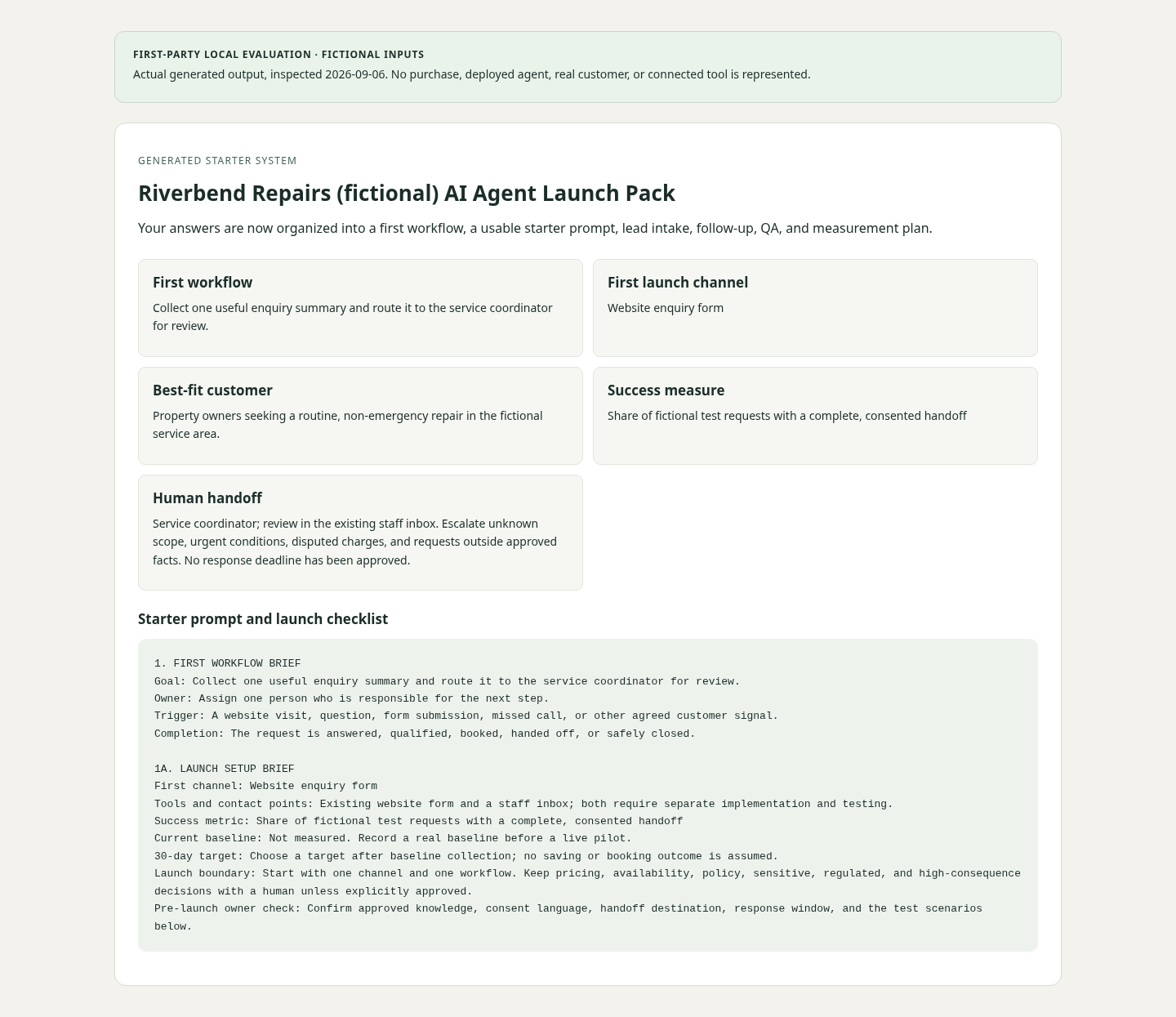
The screenshot shows actual generated output inside a labeled evaluation wrapper. We did not simulate a completed purchase, enter a private customer dashboard, test PayPal, or run the resulting prompt against an AI model. A successful text-generation assertion is not evidence of a successful customer conversation.
What comes out of a complete brief
The fixture named one channel, one outcome, an approved knowledge boundary, and a human owner. Those details appeared in the resulting pack. The workspace also surfaced the channel, target customer, success measure, and handoff in summary cards. That is a useful review surface: a manager can spot a vague goal or missing owner before somebody begins wiring tools together.
| Observed output | What it helps with | What remains yours |
|---|---|---|
| Workflow and launch setup brief | Names the job, channel, tools, baseline, and target | Choose an actual owner and verify the operational process |
| Starter system prompt | Repeats approved knowledge and escalation boundaries | Test a selected model and constrain its tools |
| Intake and follow-up material | Separates contact consent from marketing permission | Build storage, consent handling, opt-outs, and integrations |
| QA and 30-day scorecard | Gives a review checklist and measurement slots | Run the scenarios and collect real results |
The tested generator produced text from the supplied fields using templates; no model call was involved. With the workspace timestamp held constant, repeated generation produced the same pack. This makes the output predictable, but it also means the generator does not independently discover missing policies, verify prices, or investigate a customer's business.
The useful guardrails are instructions, not enforcement
The generated pack tells an assistant to avoid inventing prices, availability, policies, credentials, or outcomes. It carries the supplied escalation rule and distinguishes contact consent from optional marketing permission. Its scenario checklist covers the happy path, missing information, out-of-scope requests, sensitive or urgent requests, and opt-out/failure recovery. We confirmed that those elements were present in the actual generated text.
A developer still has to enforce permissions and validate writes outside the prompt. The instruction to avoid duplicate handoffs does not implement an idempotency key. A consent checklist does not create a consent ledger. A line saying to test calendar writes does not connect or test a calendar. Treat those sections as implementation requirements.
Three limitations surfaced in the local run
Incomplete inputs still produce a pack. An empty fixture returned placeholders such as an unspecified business type and an instruction to choose a launch channel. That behavior is helpful for exploring the format, but the presence of a polished output does not mean the workflow is ready. A manager should check every placeholder before handing the pack to an implementer.
Text can be shortened without a generation error. In this source snapshot, ordinary fields were capped at 1,800 characters and approved knowledge at 3,000. We verified those boundaries with oversized synthetic input. Important rules placed after the limit could disappear. Keep the brief concise and compare generated boundaries with the original source of truth.
The intake plan starts from a generic lead workflow. The pack includes fields such as a full name and a budget or fit signal. Those may suit a sales enquiry but need reconsideration for internal maintenance, support, or privacy-sensitive processes. Our facility intake tutorial demonstrates the adaptation problem without pretending the product automatically solves it.
A sensible setup sequence
- Choose one routine task and write what successful completion means. Avoid a goal as broad as “automate the business.”
- Collect the facts staff already trust: service boundaries, policies, who owns exceptions, and which channel will launch first.
- Record an honest baseline. Our fictional input explicitly said it had no measured baseline; the example claims no saving.
- Generate the pack and review every fact, placeholder, consent field, and escalation condition with the responsible owner.
- Use it as an implementation brief. Connect tools separately, then execute the generated scenarios before a live pilot.
Should you spend $29?
Consider it if the workflow is already chosen and a structured, editable starter pack would save you time organizing requirements. You are buying a planning workspace. Check the current product and purchase details for delivery and terms; we checked the catalog price, not a completed checkout.
Start with a free written brief if you cannot yet name the user, task, owner, approved facts, and completion condition. Buy neither product simply to postpone those decisions. If your real requirement is a functioning integration, describe that requirement and obtain a separate scope rather than assuming the kit includes installation.