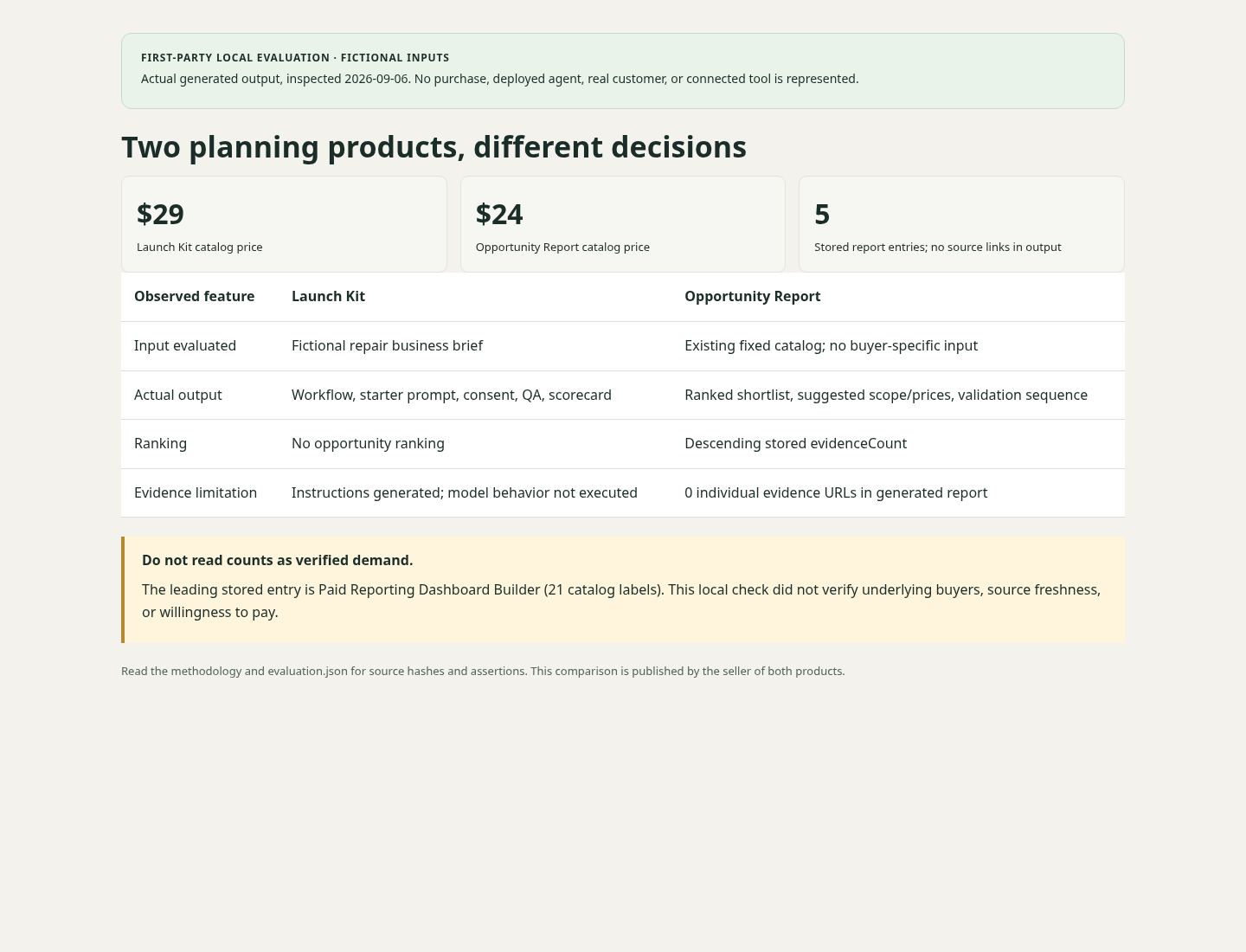
First-party disclosure: GPTMarketPlus publishes this article and sells the products discussed. We benefit if you buy them or request paid implementation. This is an examination of our own product, not an independent review. The examples use fictional inputs and local code; no purchase, customer account, deployed AI agent, or business result was tested.
The meaningful difference between these products is the question they address. The $24 AI Software Opportunity Report provides an existing shortlist of software ideas. The $29 AI Agent Launch Kit organizes a business workflow you have already selected. Choosing between them by the five-dollar price gap misses the more important issue: neither is proof that a customer will pay.
Our inspection also found a reason to be especially careful with the word “validation.” The current report is generated from a fixed local catalog. It is not a buyer-specific research workspace, and its generated output contains no individual evidence URLs. If you need a source-linked demand study, do not buy this version expecting one.
What the local evaluation actually exercised
For the kit, we ran the existing exported workspace builder, pack generator, and renderer against a fictional repair-business brief. For the report, its generator is private inside the Worker module. We evaluated the exact report-function source and catalog in an isolated local JavaScript context. This avoided creating an order, bypassing a customer account, or contacting a payment provider. The evaluation record identifies the functions, source snapshots, assertions, and limitations.
This method tells us what those product implementations generate. It does not test whether live payment and delivery work, whether a catalog opportunity is commercially attractive today, or whether customers want a particular build.
Side-by-side: inputs, deliverables, and missing proof
| Question | AI Software Opportunity Report | AI Agent Launch Kit |
|---|---|---|
| Catalog price checked | $24 once | $29 once |
| Input used by the tested generator | Existing product catalog; no buyer-specific brief | Business, offer, goal, facts, channel, owner, and measurement fields |
| What it produces | Ranked shortlist, scope and price labels, proposed validation sequence | Workflow, starter prompt, intake and follow-up material, QA, scorecard |
| Main decision it can organize | Which listed idea to investigate next | How to describe one chosen workflow before implementation |
| What it does not establish | Demand, unique buyers, current budgets, or willingness to pay | Model reliability, installed integrations, or operational improvement |
The report's ordering is simpler than a market assessment
The tested report contained five entries. Its ranking function sorted them by the stored evidenceCount field. The top entry was Paid Reporting Dashboard Builder with a catalog count of 21. The generator did not use buyer interviews, your industry, your delivery skills, your distribution access, or your implementation budget to produce that ordering.
We found zero individual evidence URLs in the generated report. Consequently, this evaluation cannot tell you whether the labels represent recent posts, repeated references to the same problem, unique prospective buyers, or opportunities still accepting proposals. Do not convert a stored count into a conversion rate or revenue forecast.
The corrected local Markdown evaluated for this article explicitly labels the legacy counts as unverified and says the report is not personalized. Its product-level count now matches the sum of its five stored entries. Those improvements make the description more accurate; they do not add source links, validate the labels, or turn the shortlist into evidence of demand.
The date displayed by the generator is the report-generation date. It is not, by itself, a date for the underlying research. A report generated today can still reflect an older catalog. Before paying for a research product, ask what sources you receive, when those sources were collected, and which decision the evidence can actually support.
The kit is more specific to your inputs, but that is not validation either
Our kit fixture supplied a narrow enquiry-routing task and a coordinator who would confirm price and availability. Those details appeared in the generated prompt and workflow. This made the artifact more specific to the fictional business than the report's fixed shortlist.
Specificity is useful for an implementation brief, but it does not make the input true. If an owner enters an unsupported service promise or an unrealistic 30-day target, a text template can carry that assumption forward. The full Launch Kit review explains the completeness checks, field limits, and human review still needed.
A free decision checklist before either purchase
- Name the decision. Are you selecting a problem to investigate, documenting a known workflow, or trying to buy implementation? Those are different purchases.
- Write one buyer or user role. “Small businesses” is too broad to reveal who controls a budget or owns the next action.
- Describe the current workaround. Record what happens, how often, which information gets lost, and who feels the consequence. Label estimates as estimates.
- Identify the next missing fact. If it is willingness to pay, neither a prompt pack nor a stored count can answer it. If it is routing ownership, start with the operational team.
- Set a stop condition. Decide which finding would make you abandon or revise the idea before you spend time integrating tools.
You can write those answers in an ordinary document at no product cost. If you cannot yet answer them, an additional template is unlikely to resolve the uncertainty on its own.
Which choice fits which situation?
“I want a short list of ideas to investigate.” The report may fit if you specifically want its existing catalog and accept the source-traceability limitation. Review the current report description before paying. Our evaluation does not justify choosing the top item simply because it has the highest count.
“I already have a recurring task and need to brief a developer.” The kit is the closer match. Bring approved facts, an owner, an initial channel, and a measurable completion condition. Its useful outcome is a reviewable brief; the implementation remains separate.
“I need to know whether buyers will pay,” or “I need it running.” Neither product supplies that result. Do the relevant research or define a separate implementation scope. There is no requirement to buy both, and moving from the report to the kit should follow a real decision rather than an automatic upsell.